
Scope changes informally
Site instructions extend work beyond the work order, but quantity and rate limits are not updated. The dispute appears when the subcontractor submits a bill.
Construction subcontractor management software
Built for project commercial teams, quantity surveyors and project managers. Connect the subcontract work order with measured progress, prior payments, deductions and retention before establishing the payable amount.
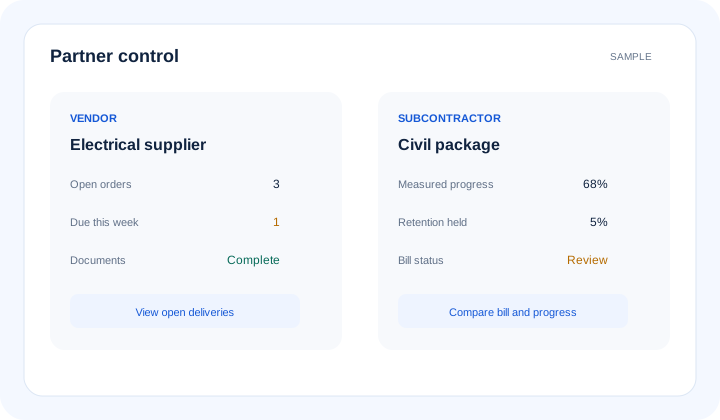
What is construction subcontractor management software? Construction subcontractor management software links onboarding, work orders, scope and quantity limits, progress records, measurement references, advances, deductions, retention, bills and reconciliation. It helps authorised commercial teams establish liabilities from recorded evidence; it does not independently measure, certify or approve completed work.
The operational problem
Site instructions extend work beyond the work order, but quantity and rate limits are not updated. The dispute appears when the subcontractor submits a bill.
Measurements sit with site teams while prior bills sit with finance. Reviewers cannot see what was certified, paid or carried forward.
Advances, material recovery, deductions and retention live in separate registers. The payable amount is overstated or takes days to reconcile.
Connected EPC records
The subcontract record ties the work order to the project package. Progress and measurement references support the current bill, while prior payments, recoveries and retention explain the net payable and outstanding liability.
Core capabilities
Record package scope, quantities, rates and configured limits. Give reviewers a controlled basis for bill assessment.
Connect reported work with the relevant project and package. Avoid billing against progress held only in a site spreadsheet.
Reference the measurements and evidence used by authorised certifiers. Preserve professional judgement and approval.
Track recorded advances and their recovery status. Prevent outstanding amounts from disappearing between bill periods.
Apply configured recovery and deduction records with visible reasons. Make the net position explainable to commercial reviewers.
Calculate or record retention under configured commercial terms. Keep retained value distinct from current payment and released amounts.
Reconcile certified value, prior payments and current payable amounts. Give finance a traceable project liability.
Product walkthrough
For example, a certified value of 100 less 20 previously paid, 10 advance recovery, 5 deductions and 5 retention leaves 60 payable, subject to authorised review.
Operational takeawayThe view gives authorised teams a shared record for the next decision; it does not replace physical verification or professional judgement.
Feature workflow
Role-based value
Compare measured quantities with work-order limits and prior certified values.
Review rates, advances, deductions, retention and outstanding obligations.
See package progress and unresolved subcontract issues affecting delivery.
Pay approved net liability with traceable recoveries and project allocation.
Lois AI in this workflow
Lois works with permitted Supista data and does not bypass configured validations, permissions or approvals.
“Compare this bill with measured progress and work-order limits.”
“Show unrecovered subcontract advances.”
“Explain the proposed payable amount.”
Connected EPC lifecycle
Proof and deployment confidence
Work-order fields, measurement references, recovery types, retention rules and approvals can reflect the agreed process. Authorised professionals remain responsible for scope interpretation, measured progress, entitlement and certification.
Buyer questions
It connects subcontract scope, progress, measurements, advances, deductions, retention, bills, payments and outstanding liability in project context.
Where scope, rate and quantity records are configured, authorised users can compare a bill with those limits and review exceptions.
The reviewed value is reconciled with prior payments, applicable advance recovery, deductions and retention under configured terms, then routed for authorised approval.
No. Engineers, quantity surveyors and authorised commercial reviewers remain responsible for measurement, entitlement and certification.
Yes. Available advance, recovery, retention and release records can be shown by subcontract and project to authorised users.
No. Lois may prepare a comparison or reconciliation from permitted records, but configured validations, permissions and approval workflows remain in control.
Use a real workflow
Bring a work order, measurement format or sample bill. We’ll show how scope, recoveries, retention and payable value can remain traceable.
Book a free strategy session with our Automation Experts and discover how Supista’s AI-Composable ERP can transform your operations into a scalable and intelligent system.